
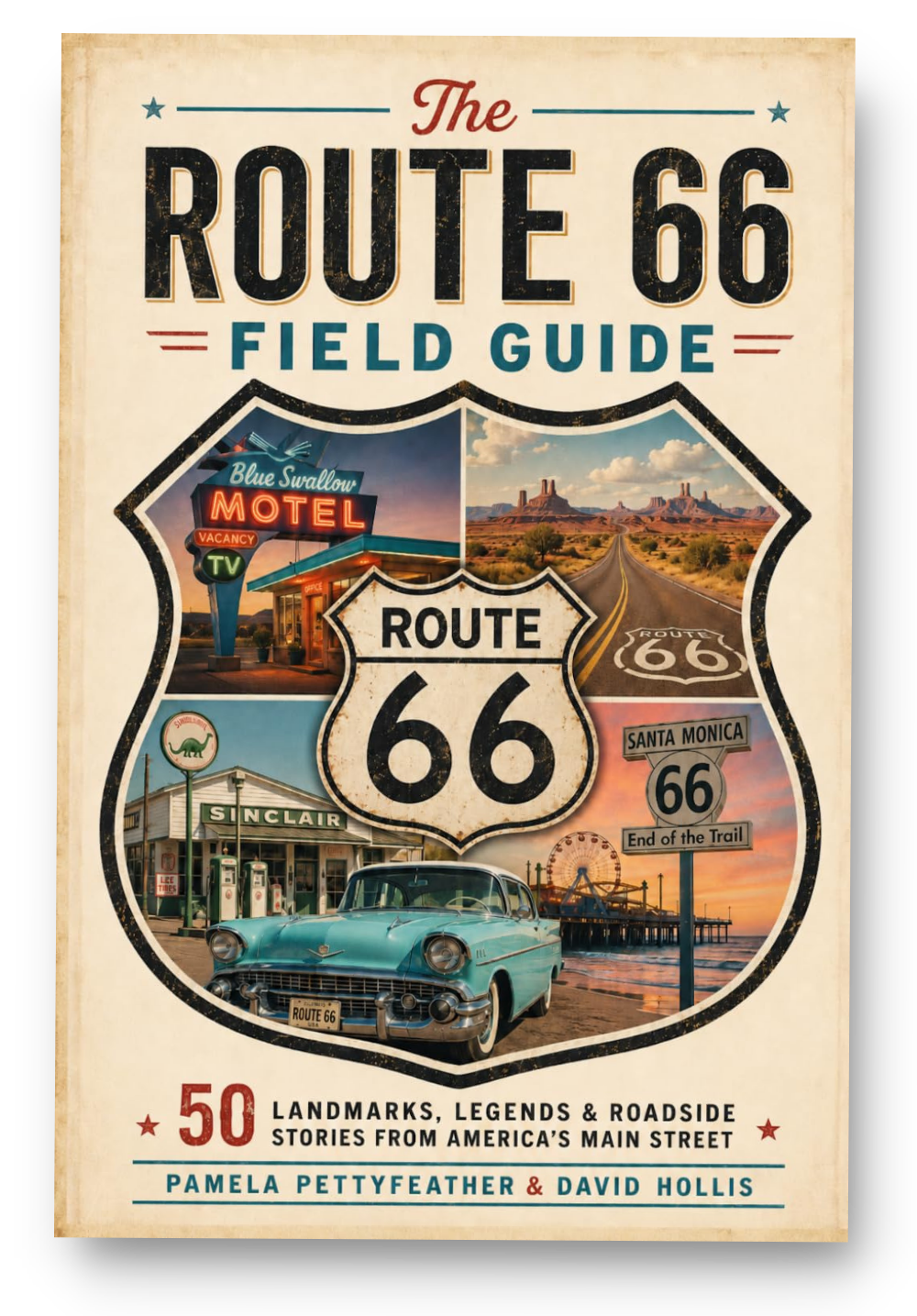
This article draws from The Route 66 Field Guide: 50 Landmarks, Legends & Roadside Stories from America's Main Street, a 50-landmark guide to Route 66 across all eight states.
Totem Pole Park, Foyil, Oklahoma: Ed Galloway's 24-Year Masterpiece
The county road that leads to Totem Pole Park in Foyil, Oklahoma, gives no preparation for what it contains. The surrounding country is flat, green, and unremarkable: northeastern Oklahoma farmland doing what northeastern Oklahoma farmland does, which is mostly to extend in all directions without comment. Then the park appears: a ninety-foot concrete totem pole rising above the treeline, surrounded by smaller poles, a stone building covered in embedded objects, and an atmosphere of sustained private ambition that the landscape around it has no framework to explain.
Ed Galloway built this. He built it alone, over twenty-four years, beginning in 1937 when he was in his early sixties and had recently retired from a career teaching manual arts in Tulsa. He mixed and poured his own concrete. He carved the figures by hand. He reinforced the structure with miles of wire armature. He finished in 1961 and died the following year, having spent the better part of his retirement producing one of the most extraordinary folk art environments in the United States in a field outside a town of a few hundred people, four miles off a federal highway, for no audience in particular.
Totem Pole Park, Foyil, Oklahoma: Essential Facts
Builder: Ed Galloway, retired manual arts instructor from Tulsa Construction period: 1937–1961 (24 years, working alone) Main pole: 90 feet tall, 11-sided, concrete and reinforced steel Material used: Approximately 28 tons of cement, poured by hand Also on site: 11 smaller poles, the Fiddle House, Galloway's collection of 300+ carved fiddles Route 66 connection: 4 miles east of the Route 66 alignment near Foyil, between Claremore and Chelsea Admission: Free | Maintained by: Rogers County, Oklahoma
Totem Pole Park on Route 66 is the largest hand-carved totem pole complex in the United States and one of the most significant folk art environments in the country. It is open during daylight hours at no charge.
Who Was Ed Galloway?
Edward Galloway was born in 1880 in Missouri and spent most of his working life as a manual arts instructor in Tulsa, Oklahoma, teaching woodworking and related skills at the school that would eventually become Will Rogers High School. He was a craftsman by training and by temperament, with a particular interest in the decorative traditions of Native American cultures, which he had studied through books, museum collections, and his own observations over decades in Oklahoma.
He was not an outsider artist in the sense that term is sometimes applied dismissively, a self-taught eccentric working in isolation from any cultural tradition. He was a trained craftsman with a developed aesthetic sensibility and a deep, if eclectic, engagement with the visual cultures he was drawing from. What made him unusual was not his skill but his scale. At the moment most people are settling into retirement's limitations, Galloway decided to make something enormous.
He bought eleven acres outside Foyil and started pouring concrete in 1937. There was no blueprint. There was no patron. There was no stated reason beyond the work itself and whatever private logic of ambition and craft drove a sixty-year-old retired schoolteacher to spend the next two and a half decades building a monument in a field.
Building the Totem Pole: What It Took
The main totem pole at Foyil is ninety feet tall and eleven-sided, an unusual geometry that Galloway chose over the circular cross-section typical of Pacific Northwest carved poles, and that gives the structure an angularity visible even from a distance. The construction method was not carving but casting and shaping: Galloway built a central armature from steel and reinforced it with wire, then applied concrete in layers, working the surface while the material was still workable to produce the carved figures and decorative elements that cover the pole from base to summit.
The Scale of the Project
The material quantities involved are staggering for a solo project: approximately twenty-eight tons of cement over the course of construction, with aggregate and sand additional. The wire armature required miles of material, integrated into each section as the pole rose. Galloway worked without powered equipment for most of the project, the mixing, the forming, the finishing were all done by hand, section by section, year by year.
The imagery on the pole draws from multiple traditions simultaneously. Pacific Northwest totem pole conventions provided the general structural logic: stacked figures, one above another, reading from base to summit. But the specific figures Galloway carved reflect a broader and more eclectic engagement with Indigenous visual traditions across the continent, filtered through his own ornamental instincts and the reference materials available to him in rural Oklahoma in the 1940s and 1950s. The result belongs entirely to no tradition except the one Galloway was building as he worked.
The surrounding park developed alongside the main pole. Galloway built eleven smaller totem poles of varying heights, placed around the property to extend the environment he was creating. He constructed the Fiddle House, a stone building whose exterior is embedded with arrowheads, colored glass, ceramic fragments, and other collected objects, to house his collection of hand-carved fiddles, which numbered in the hundreds by the end of his life. Each fiddle was functional. Each was ornamented. The collection was, in Galloway's estimation, as central to the park as the totem poles themselves.
He finished the main pole in 1961. He died in 1962, having spent more of his retirement building the park than most people spend on the totality of their working lives.
What to See at Totem Pole Park Today
The main totem pole is the immediate fact of the place. Ninety feet reads differently at the base than it does from a photograph or a description, the scale requires the eye to travel, and traveling upward reveals figures that the overview obscures. The eleven-sided geometry means the pole presents a different profile as you walk around it, the carved surfaces catching the Oklahoma light in ways that shift through the day. Morning is best: the eastern faces are lit directly, the carving is defined by shadow, and the surrounding park is quiet enough to hear whatever is happening in the trees.
The smaller poles reward slower attention than the main structure. Several are carved in distinct stylistic registers from the primary pole, suggesting that Galloway's approach to the imagery shifted over the two and a half decades of construction. The variations are not inconsistencies; they are a record of a developing practice. Looking at the poles in sequence is something like reading a craftsman's working notebooks.
The Fiddle House is not always open, but the exterior is accessible and worth examining closely. The embedded objects (arrowheads collected from the surrounding land, colored glass, ceramic fragments, and pieces of stone) are arranged with a care that reveals itself in stages. The building is small and dense with information, the visual equivalent of a cabinet of curiosities reduced to architectural scale.
The park is maintained by Rogers County, which means the maintenance level reflects municipal resources rather than the ambitions of a well-funded historic site. The grounds are clean and the main pole is structurally sound, but the experience is unmediated in a way that managed heritage sites are not. There is no visitor center. There is no interpretive apparatus to smooth over the strangeness of what Galloway built. The park exists in a field, off a county road, on its own terms.
The Preservation Story
Galloway's death in 1962 left the park without a clear guardian. The property was eventually donated to Rogers County, which lacked the specific expertise and budget to address the structural challenges that concrete folk art environments present. Over the following decades the park deteriorated through exposure to Oklahoma's weather, freeze-thaw cycles, and the simple passage of time worked against a structure that had been built without the redundancy that professional engineering would have provided.
A significant earthquake in 1989 cracked the main pole and prompted urgent assessment of the structure's condition. The damage was serious enough to raise the possibility that the pole might not be repairable. The Kansas Grassroots Art Association, an organization dedicated to the documentation and preservation of folk art environments across the Great Plains, took on the project, funding and managing a restoration effort that repaired the cracks, reinforced the armature, and stabilized the pole against further seismic and weather damage.
The restoration work completed in the early 1990s returned the park to visitable condition and secured the main pole for the foreseeable future. The effort drew national attention to Totem Pole Park within the folk art preservation community and helped establish Galloway's work as a significant example of the American self-taught art environment, a category that includes sites like Watts Towers in Los Angeles, the Coral Castle in Florida, and the Garden of Eden in Kansas.
Rogers County continues to maintain the property. Admission is free. The park is included on Oklahoma's official Route 66 heritage tourism maps and is documented by the Smithsonian Institution's Archives of American Art, which holds materials related to Galloway's life and work.
Totem Pole Park in Context: Route 66's Folk Art Tradition
Route 66 produced a remarkable concentration of single-artist folk environments: places where one person's sustained creative effort transformed a private property into something that exceeded any reasonable expectation of what individual human ambition and craft could produce without institutional support. Watts Towers in Los Angeles, built by Italian immigrant Simon Rodia over thirty-three years, is the most famous example. But the Route 66 corridor has its own inventory: Elmer's Bottle Tree Ranch in Oro Grande, California; Red Oak II in Carthage, Missouri, where artist Lowell Davis literally rebuilt a ghost town in a field; the Madonna of the Trail statues at intervals along the old National Old Trails Road.
Totem Pole Park belongs to this tradition at its most ambitious end. The scale of the main pole and the comprehensiveness of the surrounding environment, the smaller poles, the Fiddle House, the carved fiddle collection, placing it in the company of the half-dozen most significant folk art environments in the United States. That it sits on a county road in northeastern Oklahoma, with no gift shop, no admission fee, and no interpretive infrastructure to soften the encounter, is part of what makes it worth the detour.
The four miles from the Route 66 main corridor to the park is four miles well spent. The road gives no indication of what it's leading to, which is exactly the condition most folk art environments require. Surprise is the appropriate mode of arrival.
Visiting Totem Pole Park on Route 66: What to Know
Location: 21300 E. Hwy 28A, Foyil, Oklahoma 74031. Approximately four miles east of the Route 66 alignment near Foyil, between Claremore and Chelsea.
Getting there: From Route 66 in Foyil, follow the signs east on Highway 28A. The park is on the south side of the road. The turn is marked but easy to miss at speed. Slow down through town.
Hours: The park is generally open during daylight hours. Rogers County maintains the site; call ahead if visiting during off-peak months as seasonal access can vary.
Admission: Free.
Time needed: Allow forty-five minutes to an hour to see the park properly: main pole, smaller poles, Fiddle House exterior, and the surrounding grounds. The park rewards slower examination than most visitors give it.
Combining with other stops: Totem Pole Park is four miles off Route 66 between Claremore and Chelsea, Oklahoma. Claremore is the birthplace of Will Rogers and has a well-maintained Rogers museum worth an additional hour. The Blue Whale of Catoosa is roughly thirty miles west on Route 66, both can be done in a half-day Oklahoma folk art circuit.
Photography: The main pole is best photographed in morning light (east face lit) or late afternoon (west face lit). Midday produces flat results. Stand at the base and shoot upward for the most dramatic composition; step back to the park's perimeter for the full-height profile.
Totem Pole Park and the Route 66 Folk Art Tradition
Galloway's park belongs to a broader tradition the highway generated at unusual density: Elmer Long's Bottle Tree Ranch in Oro Grande, California; Red Oak II near Carthage, Missouri, where folk artist Lowell Davis physically rebuilt a ghost town in a field; the Blue Whale of Catoosa, Oklahoma, built as a private anniversary gift and opened to the public because Davis saw no reason not to.
Route 66 Field Guide: 50 Landmarks, Legends & Roadside Stories from America's Main Street covers Totem Pole Park alongside these other major Route 66 folk art environments, each at full depth, with the story behind the builder, the construction, and the preservation effort that kept them standing. The Oklahoma chapter alone covers eight stops including Blue Whale, POPS, Golden Driller, and the Totem Pole.
Frequently Asked Questions
What is Totem Pole Park in Foyil, Oklahoma? Totem Pole Park in Foyil, Oklahoma, is a folk art environment built by retired schoolteacher Ed Galloway between 1937 and 1961. The park's centerpiece is a ninety-foot concrete totem pole, the largest hand-carved totem pole in the United States, surrounded by eleven smaller poles, a stone outbuilding called the Fiddle House, and a collection of hand-carved fiddles that Galloway made over the same period.
Who built the Totem Pole Park in Oklahoma? Edward Galloway, a retired manual arts instructor from Tulsa, Oklahoma, built Totem Pole Park beginning in 1937 when he was in his early sixties. He worked alone for twenty-four years, mixing and pouring his own concrete and carving each figure by hand, before completing the main pole in 1961. He died in 1962.
How tall is the totem pole in Foyil, Oklahoma? The main totem pole at Totem Pole Park is ninety feet tall. It is eleven-sided rather than circular, constructed from concrete and steel reinforced with wire armature, and covered from base to summit in carved figures drawing from multiple Indigenous visual traditions.
Is Totem Pole Park on Route 66? Totem Pole Park is approximately four miles east of the Route 66 main corridor near Foyil, Oklahoma, between Claremore and Chelsea. It is documented on Oklahoma's official Route 66 heritage tourism maps and is one of the most significant folk art destinations in the Route 66 corridor's Oklahoma section.
Is Totem Pole Park free to visit? Yes. Totem Pole Park in Foyil, Oklahoma, is maintained by Rogers County and is free and open to the public during daylight hours.
What is the Fiddle House at Totem Pole Park? The Fiddle House is a stone outbuilding that Ed Galloway constructed on the Totem Pole Park property to house his collection of hand-carved fiddles, functional, ornately decorated instruments he made throughout the same period he was building the totem poles. The building's exterior is embedded with arrowheads, colored glass, ceramic fragments, and collected objects, and is as much a folk art environment as the poles themselves.