
Blue Swallow Motel, Tucumcari, New Mexico: The Finest Motor Court on Route 66
The neon sign comes on at dusk without ceremony, the swallow diving toward the vacancy indicator, the motel name in a mid-century script that manages to be both legible and elegant, the whole assembly glowing turquoise and coral against the New Mexico sky. There is no moment on Route 66 that more precisely delivers what the highway has always promised, which is the specific feeling of having arrived somewhere that was expecting you.
The Blue Swallow Motel in Tucumcari has been generating that feeling since 1939. It is, by any serious measure, the finest surviving motor court on the route, not because it is the largest or the most famous or the most photographed, though it is all of those things within its category, but because it is the most complete. The attached garages, the hand-painted room numbers, the original neon, the U-shaped motor court layout, the scale calibrated to thirty travelers rather than three hundred: these elements exist together as a coherent environment that eighty-five years of continuous operation have refined rather than diluted. You can stay here, in a room that has been receiving travelers since the Truman administration, in a building whose neon sign predates the interstate highway system that nearly ended it, and the experience has no adequate substitute anywhere on the route.
Blue Swallow Motel, Tucumcari, NM: Quick Facts
Address: 815 E. Tucumcari Blvd, Tucumcari, New Mexico Built: 1939 by W.A. Thompson | Status: Open (working motel; advance booking recommended) Units: Approximately 12, each with an attached individual garage original to 1939 Neon sign: Original 1939 design, continuously operational for over 85 years National Register: Listed on the National Register of Historic Places Key owner: Lillian Redman, 1958–1998 (40-year tenure defining the motel's character) Best time to visit: Dusk, when the sign comes on against the New Mexico sky
The Blue Swallow Motel in Tucumcari is the finest surviving motor court on Route 66 and the best individual overnight stop on the full 2,278-mile alignment. Book well in advance for summer travel, the motel fills consistently from May through September.
What a Motor Court Was and Why It Mattered
To understand the Blue Swallow, it helps to understand what the motor court was solving for.
The first generation of Route 66 accommodation was the tourist cabin, a rudimentary arrangement of small freestanding structures, usually unheated, sometimes unplumbed, grouped loosely around a central office. The cabins were cheap and often disreputable; John Steinbeck's description of the migrant camps in The Grapes of Wrath gives a sense of how far the lower end of the tourist cabin market was from comfortable, and respectable travelers of the 1930s approached the category with justified wariness.
The Motor Court Format
The motor court was the next evolution, a more deliberately designed accommodation format that addressed what travelers actually needed. Rather than isolated cabins, motor courts grouped their units around a central courtyard, typically in a U-shape, with the office at the open end facing the highway. The units shared walls or were closely adjacent, which allowed for better construction quality at a lower cost per room. The courtyard arrangement gave travelers a semi-private common area and allowed the property to present a coherent face to the road.
The Attached Garage
What distinguished the finest motor courts from the merely adequate ones was the attached garage. A private garage for each unit, a feature the Blue Swallow incorporated into its original 1939 design, was a significant amenity in the context of how families actually traveled. In an era before luggage with locks, before credit cards, before travelers checks were universal, the family car contained everything of value a traveler possessed: luggage, cash, documents, often the tools and spare parts that made the drive possible. A garage attached to the room meant the car was locked and secured, the luggage stayed in the car, and the traveler slept thirty feet from everything they owned. It was not a luxury. It was a practical solution to a genuine problem, executed at a standard that most of the Blue Swallow's competitors never matched.
The History: W.A. Thompson and the First Guests
W.A. Thompson built the Blue Swallow in 1939, establishing the property on what was then a busy commercial stretch of Route 66 through Tucumcari. Thompson chose the U-shaped motor court format that was becoming standard for quality roadside accommodation, but he went further than most competitors in the specifics: individual garages for each unit, solid masonry construction, a property scale that prioritized the quality of each room over the quantity. The Blue Swallow was built to be better than it needed to be, which turned out to be the correct business decision.
Tucumcari in 1939 was well-positioned to support quality accommodation. The town sat at a natural overnight stopping point on the long westbound drive across New Mexico, far enough from Amarillo that travelers needed a bed, close enough to Albuquerque that a night in Tucumcari made the next day's drive manageable. The commercial strip along what is now Tucumcari Boulevard was already developing the motel density that would eventually support the city's claim of two thousand rooms. Thompson's property entered a competitive market and differentiated itself through quality rather than price.
The motel traded through its first two decades under several owners, operating successfully through the postwar surge in highway travel that filled every decent motor court in the Southwest with families heading west. By 1958, when Lillian Redman purchased the Blue Swallow, the property was well-established and its neon sign was already a recognizable fixture of the Tucumcari corridor.
Lillian Redman: Forty Years That Defined the Blue Swallow
Lillian Redman ran the Blue Swallow from 1958 to 1998, forty years, longer than the motel had existed when she bought it, long enough to define its character so thoroughly that every subsequent owner has maintained the identity she established. She is the reason the Blue Swallow is what it is.
Redman operated the motel as a personal enterprise of considerable precision. The rooms were clean in the specific way that a single proprietor keeps rooms clean, which is different from the institutional cleanliness of a chain: thorough, particular, reflecting the standards of a specific human being rather than a corporate specification. The neon worked. Guests were received as guests: people who had been driving all day and needed a bed, not as transactions to be processed. The distinction sounds small and is not.
What Redman did with the motel over four decades was to resist. She resisted the pressure to expand, which would have required compromising the attached garage format or the courtyard scale. She resisted the pressure to franchise, which would have imposed standards developed elsewhere for properties nothing like the Blue Swallow. She resisted the pressure (enormous during the 1970s and 1980s, when the interstate bypass had stripped Tucumcari of its through-traffic and the commercial strip was visibly contracting) to simply close and let the building become what so many of its neighbors became: a structure in managed decline, maintained just enough to avoid the cost of demolition.
She is also reported to have offered free lodging, quietly and without advertising, to travelers who had run out of money. The road attracted people in difficulty alongside people on vacation, and Redman seems to have understood that the motel's function extended beyond commercial hospitality. She did not publicize this practice. It appears in the recollections of people who encountered it, which is a more reliable record than any formal statement.
Redman sold the Blue Swallow in 1998. She had run it for forty years. The property was in better condition than it had been when she arrived.
The Neon Sign: What Makes It the Best on the Route
The Blue Swallow's neon sign is, by the assessment of most Route 66 historians and neon preservation specialists, the finest original-era commercial neon installation surviving on the highway. The claim is worth unpacking.
The sign's distinction is not its size (there are larger Route 66 signs), or its age, though it is old, or its condition, though it is excellent. The distinction is the quality of the design and fabrication relative to what the sign was asked to do.
The swallow in the sign has to read as a bird in motion from a moving car at a distance of half a mile. This is a specific and demanding design problem. A static silhouette of a swallow would read as a shape; a shape does not convey a diving bird at the speeds and distances relevant to highway travel. The neon artist who designed the Blue Swallow sign resolved the problem through the arrangement of the tube work: the wing angle, the body taper, and the relationship between the bird and the surrounding negative space together create an impression of velocity and direction that resolves into a specific image (swallow, diving) at the exact distance the sign needed to work. It is a small masterpiece of commercial graphic design executed in a medium that permits very little revision and no erasure.
The sign has been maintained and restored over the decades. The transformer has been replaced; tubes that cracked have been remade to the original patterns. The sign that glows over the Blue Swallow's parking lot tonight is functionally continuous with the sign that first came on in 1939, which makes it one of the oldest continuously operating neon commercial signs in New Mexico.
A fuller account of Tucumcari's neon culture, the broader corridor of which the Blue Swallow sign is the finest single example, which appears in the Route 66 Neon Signs guide.
The Architecture: Reading the Motor Court
The Blue Swallow's layout is a textbook U-shaped motor court: the office at the open end facing the highway, the guest units arranged along both arms of the U, the courtyard in the center. Within that standard format, the specific decisions Thompson made in 1939 remain legible.
The attached garages give the property its distinctive rhythm, each unit reads as a paired element, the room door and the garage door side by side, the whole arrangement suggesting a kind of domestic scale that chain hotels of any era cannot replicate. The garages are not oversized; they accommodate a normal passenger car with appropriate clearance. They are exactly what they need to be, which is a more disciplined architectural decision than it sounds.
The masonry construction (concrete block beneath the stucco exterior) gives the units a thermal mass that makes them noticeably cooler in summer than the wood-frame construction that characterized cheaper motor courts. New Mexico summer heat is serious; a room that holds its overnight temperature through the afternoon is a genuine amenity, and it is one that the Blue Swallow provides without any mechanical assistance that did not exist in 1939.
The courtyard is small enough to be social without being intimate, the distance between facing units is sufficient for privacy, the shared space sufficient for the particular kind of brief highway acquaintance that motor courts generated at their best: a nod across the courtyard in the morning, a conversation about road conditions, the exchange of information between people who have no other connection than having stopped at the same place on the same night.
Staying at the Blue Swallow Motel in Tucumcari: What to Expect
The Blue Swallow is a working motel. This means it has the practical infrastructure that phrase implies (beds, bathrooms, functional plumbing, climate control) updated sufficiently for contemporary use without altering the architectural character that makes staying here different from staying anywhere else.
What it does not have is the infrastructure of a larger property: no pool, no on-site restaurant, no conference facilities, no fitness center. The Blue Swallow has rooms, garages, a courtyard, and a neon sign. These are sufficient.
Book in advance. The motel has a limited number of units, the motor court format is not compatible with large inventory and it fills consistently through the summer months and during Route 66 heritage events. Same-day availability through summer and fall is unreliable.
The garage attached to each unit is functional and lockable, which means the original purpose is still served. Park in the garage, lock the door, sleep thirty feet from your car. The experience is a specific kind of competence, the motor court doing what the motor court was designed to do, that carries more satisfaction than it might seem to on paper.
The neon outside the window is not a nuisance. It is the view. The particular quality of blue-green light that the sign casts across the courtyard at night is the aesthetic experience for which the property was designed, and it is best appreciated from a room at the far end of either arm of the U, where the sign reads in full across the width of the courtyard. Request a room at the far end when booking.
Wake up in the morning and stand in the courtyard for five minutes before checking out. The motor court at that hour, the light coming over the parapet, the garages locked, the sign dark, is the Blue Swallow at its most specific, the experience you will have difficulty describing accurately to someone who has not had it.
Booking: The Blue Swallow Motel books through its own website and through standard online booking platforms. Rates are reasonable relative to the experience being purchased. The motel's calendar fills well in advance for peak travel months; booking sixty to ninety days out is advisable for summer travel.
The Blue Swallow and Route 66's Motor Court Era
The Blue Swallow Motel Tucumcari represents the motor court form at its most complete, a category that once appeared every sixty to ninety miles along Route 66 from Chicago to Santa Monica. Most are gone. The Blue Swallow survives because of forty years of principled ownership by Lillian Redman and because every subsequent owner understood what they had inherited.
Route 66 Road Trip: 50 Landmarks, Legends & Roadside Stories from America's Main Street (release date 6/2/26) covers the Blue Swallow alongside the other essential Route 66 overnight stops: the Wigwam Motel in Holbrook, Arizona (concrete teepees since 1950), and Roy's Motel & Café in Amboy, California (the Mojave crossing's most isolated commercial outpost). The New Mexico chapter covers five Tucumcari and Albuquerque stops in full, including the Blue Swallow and the Tucumcari Neon Strip.
Frequently Asked Questions
Is the Blue Swallow Motel still open? Yes. The Blue Swallow Motel in Tucumcari, New Mexico, is open and operating as a working motel. It has been in continuous operation since 1939 and remains one of the most sought-after overnight stops on the Route 66 corridor.
Where is the Blue Swallow Motel? The Blue Swallow Motel is located on historic Route 66 (East Tucumcari Boulevard) in Tucumcari, New Mexico, approximately midway between Amarillo, Texas, and Albuquerque, New Mexico, on the I-40 / Route 66 corridor.
How old is the Blue Swallow Motel? The Blue Swallow Motel was built in 1939, making it more than eighty-five years old. It is on the National Register of Historic Places and is one of the oldest continuously operating motor courts on Route 66.
Why is the Blue Swallow Motel famous? The Blue Swallow Motel is famous for three things simultaneously: its neon sign, which is widely considered the finest original-era commercial neon installation on Route 66; its preservation, which has maintained the original 1939 motor court format, including the individual attached garages, in working condition; and its forty-year association with owner Lillian Redman, whose tenure from 1958 to 1998 established the motel's character and reputation.
Does the Blue Swallow Motel have original garages? Yes. Each unit at the Blue Swallow Motel has an attached individual garage, original to the 1939 design of the property. The garages are functional and lockable and represent one of the most distinctive features of the motor court format at its best.
What is the neon sign at the Blue Swallow Motel? The Blue Swallow Motel's neon sign features a swallow in diving posture, the motel name in mid-century script, and a vacancy indicator, executed in turquoise and coral neon. The sign has been in operation since the motel's 1939 opening, with maintenance and restoration work over the decades to replace failed components while preserving the original design. It is considered the finest surviving individual neon sign on the Route 66 corridor.
Who was Lillian Redman? Lillian Redman was the owner and operator of the Blue Swallow Motel from 1958 to 1998, a forty-year tenure that shaped the motel's identity and preserved its original character through the decades when the Route 66 bypass threatened every comparable property in Tucumcari. Redman maintained the motel's standards, resisted pressures to expand or franchise, and reportedly offered free lodging to travelers in financial difficulty. She is credited by preservation historians as the reason the Blue Swallow survived intact.
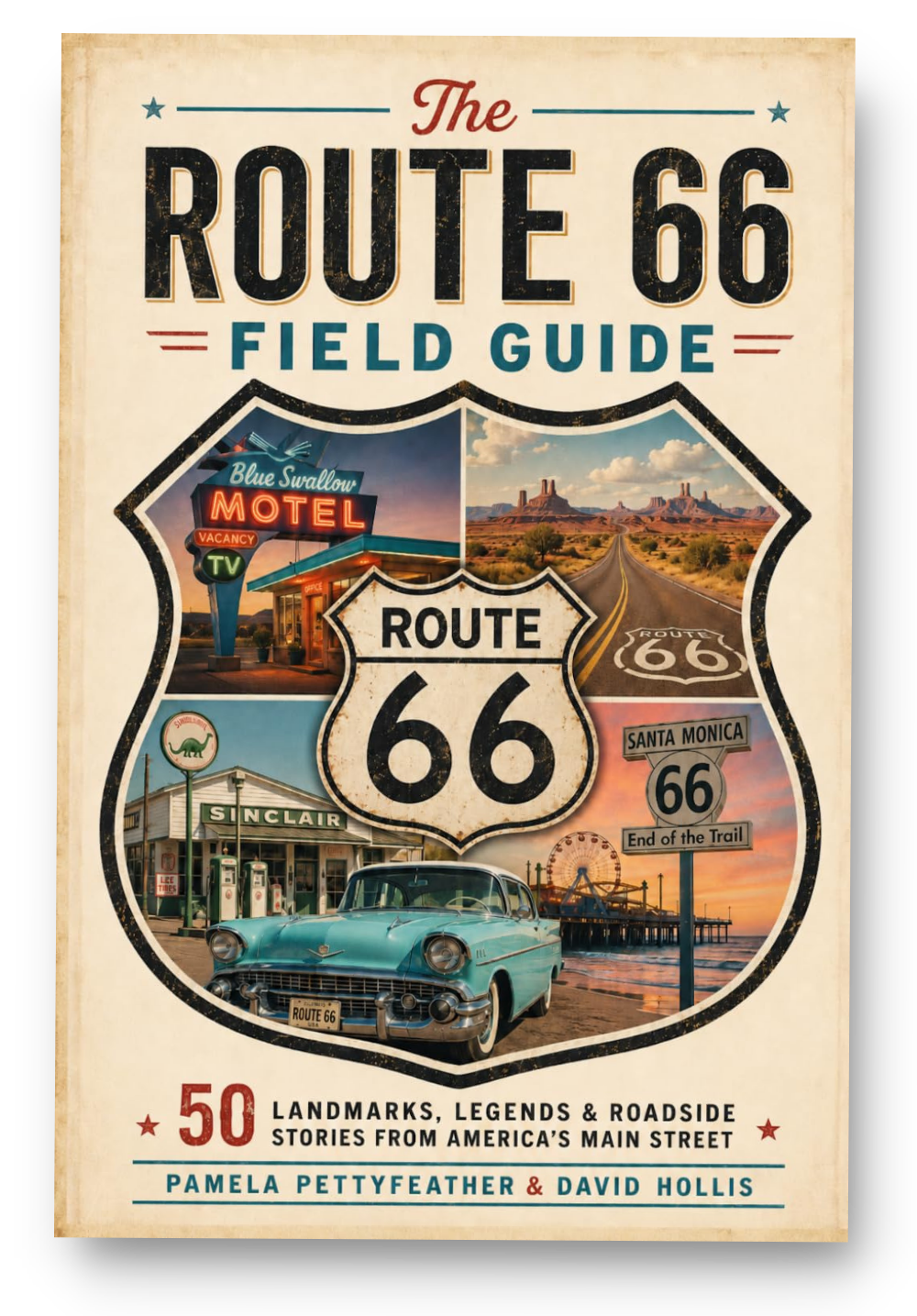
This article draws from The Route 66 Field Guide: 50 Landmarks, Legends & Roadside Stories from America's Main Street, a 50-landmark guide to Route 66 across all eight states.