
Route 66 Neon Signs: A Guide to the Best Surviving Corridors and Landmarks
Route 66 neon signs tell the story of the highway's commercial peak more clearly than almost any other surviving artifact. Neon is a gas that conducts electricity and emits colored light when it does. This is chemistry. What Route 66 did with it was something closer to culture.
Between roughly 1935 and 1965, neon signage became the primary visual language of the American roadside. The technology had existed since the 1910s, when French inventor Georges Claude demonstrated that glass tubes bent into shapes and filled with inert gas could hold illuminated letters indefinitely without burning out. American sign makers adopted the medium aggressively through the 1920s; by the 1930s, the techniques for bending, filling, and mounting neon had become standardized enough that sign shops in most mid-sized cities could produce commercial work. Route 66 was the ideal environment for the result.
A neon sign carries information, the name of the motel, the price of the gas, the availability of vacancy but it also carries something harder to quantify: a signal of intent. In a landscape where travelers were making decisions at sixty miles an hour, a lit sign was a promise. We are here. We are open. Whatever you need at this hour and in this place, we have it. The promise was made in red and amber and turquoise and the specific shade of blue that neon produces when the gas is mixed with mercury, and it was made from half a mile away on a flat stretch of highway where nothing else competed with it for the eye.
Most of that signage is gone. The interstate bypass removed the commercial rationale, the signs went dark when the businesses closed, and the glass that was not actively maintained became fragile and eventually shattered. What survives, along stretches of old alignment from Illinois to California, the record of a visual culture that lasted about thirty years and has not been replicated since.
Best Surviving Route 66 Neon Signs: Quick Reference
Where to find route 66 neon signs, ranked by concentration and condition:
Tucumcari, NM: Tucumcari Boulevard; the most concentrated surviving neon strip on the route; drive at dusk westbound
Albuquerque, NM: Central Avenue; includes the restored KiMo Theatre marquee and several motel signs
Tulsa, OK: Eleventh Street; Art Deco neon in a postwar oil-boom context
Seligman, AZ: revival neon on a functioning main street, best experienced on foot
Williams, AZ: intact neon corridor on the western end of the Arizona Route 66 alignment
The single best individual Route 66 neon sign: the Blue Swallow Motel in Tucumcari, New Mexico, an original 1939 installation featuring a swallow in diving posture, continuously operational for over eighty years.
Why Neon Became Route 66's Signature Medium
The Timing
The timing of neon's commercial spread coincided almost exactly with Route 66's operational peak. The highway was commissioned in 1926; neon signs became widely affordable for small roadside businesses through the 1930s and early 1940s. By the time postwar prosperity flooded the highway with travelers in the late 1940s and 1950s, every motor court, diner, and filling station of any ambition had a lit sign or was planning one.
Several factors made the medium particularly suited to the Route 66 environment. Desert and plains air, which covers the majority of the route west of Missouri, is dry and particulate-free, which means neon burns against it with an intensity that humid Midwest air cannot match. A sign that reads adequately in St. Louis reads brilliantly in Tucumcari. The wide, flat corridors of the Southwest give a neon sign a visual range of a mile or more at night, which is exactly what a motel operator needed when competing with three other motor courts visible from the same stretch of highway.
Why Neon Lasted
The signs were also durable. A well-maintained neon tube has a rated life of eight to fifteen years, but many original Route 66 signs have been in intermittent operation for fifty or sixty years when properly maintained. The glass does not corrode; the gas does not deplete. The failure modes are electrical: transformers burn out, wiring deteriorates and those are repairable. Neon that went dark when a motel closed has often been restored to operation decades later simply by replacing the transformer and rewiring the connections.
This is why the best neon on Route 66 can still be seen in its original locations. It was not designed to last forever, but it was designed well enough to survive long enough for preservation to become possible.
The Best Surviving Neon on Route 66
Tucumcari, New Mexico: The Neon Capital of the Highway
No town on Route 66 has a closer relationship to neon than Tucumcari. The town marketed itself for decades with a billboard campaign that promised two thousand motel rooms, an assertion that was nearly accurate in 1960 and considerably less so today and the commercial logic behind that promise was entirely illuminated. Tucumcari existed specifically to be the overnight stop between Amarillo and Albuquerque, a distance long enough to require a bed, and the neon that lined Tucumcari Boulevard was the mechanism by which the town convinced each westbound driver that stopping here, tonight, was necessary rather than optional.
The commercial strip that developed through the 1940s and 1950s produced a density of motel signs, diner signs, and service station signs that was exceptional even by Route 66 standards. The signs competed with each other for visibility in the way that businesses on a commercial strip always do, which meant they grew more elaborate and more vivid as each year passed. Roadrunners, arrows, stylized lettering, animated elements that gave the impression of movement. Tucumcari's sign makers worked in a medium that rewarded ambition.
The interstate bypass hit Tucumcari's economy with unusual directness. The two thousand motel rooms contracted by attrition and demolition to a fraction of their former number. But the surviving neon, some restored, some original, some maintained in the uncertain condition, representing enough of the strip's mid-century density to reconstruct the experience on a clear evening with the right approach speed.
Drive Tucumcari Boulevard at dusk, westbound. The signs were designed for this direction and this hour, and the experience of watching the boulevard come alive as the sky darkens behind you is one of the more specifically Route 66 things the highway still offers. A second pass on foot reveals the craftsmanship in the metalwork and glasswork that the car window compresses into pure color.
Signs to find: The Blue Swallow Motel sign (see below) is the single finest surviving example. The Lasso Motel, the Palomino Motel, and the Tepee Curios signs are all worth locating. The Tee Pee Curios sign near the center of the strip is one of the older surviving commercial neon installations in the state.
Albuquerque, New Mexico: Central Avenue
Central Avenue is Albuquerque's Route 66, and it runs through the city with a directness that the highway's rural stretches can only approximate, with sixty-odd blocks of urban corridor that the road claimed in 1926 and has never fully relinquished. The neon that remains along Central is, for the most part, still working.
The Albuquerque stretch developed its neon identity through the late 1940s and 1950s, when postwar prosperity and the particular quality of New Mexico light made illuminated signage both economically justified and visually spectacular. High desert air is dry and clear, and neon burns against it with an intensity the humid Midwest cannot match. The surviving examples (motel signs, diner signs, theater marquees) demonstrate the craft at a high level of commercial ambition.
The KiMo Theatre, a few blocks off the main commercial strip on Central, anchors the neon culture with its 1927 Pueblo Deco façade. The KiMo is not a neon installation per se, its exterior is terracotta and tile but its illuminated marquee and the way the building's ornamental detail is lit at night place it in the same visual register as the roadside neon that surrounds it. The name itself derives from a Tiwa word contributed by Pablo Abeita of Isleta Pueblo, meaning roughly "king of its kind."
The University of New Mexico campus interrupts the commercial strip midway through Central, creating a stretch of comparative quiet before the neon resumes westward, a rhythm that a continuous commercial corridor would lack and that makes the signs feel more deliberate when they reappear.
Begin at the eastern end of Central at dusk and drive west. Stop for the KiMo Theatre on foot, the Pueblo Deco detail sits largely above eye level and cannot be safely appreciated from a moving car. The most concentrated surviving neon is in the blocks between the university and the Rio Grande.
Tulsa, Oklahoma: Oil Boom Art Deco
Tulsa built itself during the oil boom decades of the 1920s and 1930s, when money arrived faster than the city could spend it and the architectural fashion of the moment was Art Deco, which meant terracotta, geometric ornament, and eventually neon. The combination of oil money, Art Deco ambition, and a Route 66 corridor running through the middle of the city produced one of the finest collections of mid-century commercial signage surviving in the American interior.
Eleventh Street through Tulsa follows the original Route 66 alignment and retains a density of vintage commercial architecture that most comparable American cities replaced long ago with something more practical and considerably less interesting. The surviving neon along this corridor, restored examples advertising motels, diners, and businesses that have cycled through several incarnations, represents a moment in American visual culture when illuminated signage was considered a form of civic decoration as much as advertising.
Tulsa's neon cannot be separated from its oil-boom origins. The city built itself with petroleum money, spent that money on architecture, and lit the architecture with the era's most expressive signage technology. The connection between the Golden Driller statue at the Expo Center, a seventy-six-foot oil worker erected in 1966 and the neon that lines Eleventh Street is direct: both are expressions of how a mid-century city that had made its fortune underground chose to present itself on the surface.
Drive Eleventh Street twice: once in daylight to read the architecture, once at dusk to see the neon. The signs were built for the second viewing, and the difference between the two passes is substantial enough to justify the extra twenty minutes.
Blue Swallow Motel, Tucumcari, New Mexico
The Blue Swallow Motel sign is the single finest surviving neon installation on Route 66. This is a claim worth making carefully, because the highway has a considerable inventory of excellent neon, but the Blue Swallow earns the designation on several grounds simultaneously.
The sign's design, a swallow diving toward a VACANCY indicator, the motel name in a confident mid-century script, the whole assembly in turquoise and red against the New Mexico dark, was executed at a level of craft that separates it from the functional commercial neon that most competitors could afford. The neon artist who designed it understood that the swallow had to read as a bird in motion from a distance, which meant the tube work needed to communicate direction and velocity rather than simply outline the shape. It does.
The sign is also original to the property, in continuous operation since the motel opened in 1939 with gaps only for maintenance and restoration. The Blue Swallow is on the National Register of Historic Places and remains a working motel. The neon outside the room window is the most atmospheric night light available at any price on the New Mexico corridor.
Book a room if the schedule allows. But the sign is worth a stop even without a reservation: pull into the lot at dusk and watch the sign come on against the Tucumcari sky, which is the experience for which it was designed.
Seligman, Arizona, Revival Neon
Seligman's main street neon is not original in the way that Tucumcari's is. Much of it was installed or restored as part of the Route 66 revival that Angel Delgadillo's 1987 organizing effort made possible. The distinction matters less than you might expect. The sign painters and neon fabricators who worked the Seligman corridor in the 1990s and 2000s understood the visual language they were extending and produced work that fits the context without pretending to be something it is not.
What makes Seligman's neon noteworthy within the highway's larger inventory is the way it coexists with a functioning town. The main street is not a heritage district or a museum environment. It is an active commercial strip where the neon advertises businesses that are open, serving customers who are local as well as tourist. The gift shops and the barbershop and the diner operate under signs that are designed to be read rather than merely photographed, and the distinction between a living neon sign and a preserved one turns out to be immediately perceptible when you stand in front of each.
Pontiac, Illinois: The Northern Anchor
The northern end of Route 66 is not typically where travelers seek neon, the Midwest's commercial strip architecture was less ambitious than the Southwest's, and much of what was built in Illinois through the postwar decades has since been demolished or converted. Pontiac is an exception. The town has invested in its Route 66 identity more deliberately than most Illinois communities, and the painted murals and restored signage along its historic alignment give it a visual character that the northern stretch of the highway otherwise largely lacks.
The Route 66 Hall of Fame and Museum in Pontiac is the most comprehensive interpretive resource on the Illinois portion of the highway, and the curated collection of sign photographs and surviving neon elements inside provides context for what the full corridor looked like before the interstate redirected its traffic. Worth an hour before continuing south toward the more dramatically surviving sections of the route.
What Happened to Route 66's Neon
The short answer is the same as what happened to Route 66 itself: the interstate happened. When businesses closed, signs went dark. Dark signs that were not actively maintained became brittle; glass tubes cracked through freeze-thaw cycles, transformer housings rusted, and mounting structures corroded. The signs that were removed when businesses changed hands often went to salvage, where the steel was recycled and the glass was discarded. The signs that were left in place had better survival odds than the ones that were taken down, which is the opposite of what preservation instinct would suggest.
The restoration economy that has developed around Route 66 neon since the 1990s has recovered a significant number of signs that would otherwise have been lost. The process typically involves replacing the transformer, repairing or replacing broken tubes using the original tube patterns as guides, repainting the steel housing, and rewiring the installation to current electrical code. The cost for a large motel sign runs from several thousand dollars to well over $100,000 depending on complexity and condition.
Several organizations support this work. The Route 66 Association chapters in New Mexico and Oklahoma have funded sign restoration projects. Individual property owners along the Tucumcari corridor have invested in their own signs as part of broader motel restorations. The National Park Service's Route 66 Corridor Preservation Program, before its funding was reduced, supported a number of survey and restoration projects that documented sign inventories across all eight states.
What has been saved is a fraction of what existed. What has been saved is also enough to experience the neon as an environment rather than an isolated artifact, which is the only context in which it fully makes sense.
The Route 66 Neon Trail: The Complete Guide
The neon corridors covered above (Tucumcari, Albuquerque's Central Avenue, Tulsa's Eleventh Street, the Blue Swallow) are covered at full depth in Route 66 Road Trip: 50 Landmarks, Legends & Roadside Stories from America's Main Street, the Route 66 centennial companion guide. Each entry includes the specific story of how the neon developed in that location, the current condition and what has been restored, and the exact time of day and vantage point that makes each one worth the stop.
The book covers fifty Route 66 landmarks across all eight states. Route 66 neon signs are one of the route's most photogenic and most historically layered categories and the book treats them as such.
Frequently Asked Questions
Where is the best Route 66 neon? The most concentrated surviving Route 66 neon is in Tucumcari, New Mexico, where the commercial strip along Tucumcari Boulevard retains enough mid-century signage to suggest what the full corridor looked like at its peak. Albuquerque's Central Avenue and Tulsa's Eleventh Street are the next best examples of neon-rich Route 66 corridors. The single finest individual sign is the Blue Swallow Motel in Tucumcari.
Is Tucumcari known for neon signs? Yes. Tucumcari, New Mexico, is the most neon-identified town on Route 66. Its commercial identity was built around a motel industry that competed primarily through signage, and enough of those signs survive (in restored or original condition) to make the town the most compelling neon destination on the highway. The Tucumcari Historical Museum documents the corridor's sign history in detail.
What is the most famous Route 66 sign? The Route 66 shield itself, the black keystone badge with the bold numerals 66, the most widely recognized symbol associated with the highway and appears on highway signs, painted road markings, and reproductions worldwide. Among neon signs specifically, the Blue Swallow Motel sign in Tucumcari, New Mexico, is widely considered the finest original surviving example on the route.
Are Route 66 neon signs being restored? Yes. Neon restoration has been an active element of Route 66 preservation since the 1990s, concentrated particularly in Tucumcari, New Mexico, Tulsa, Oklahoma, and Seligman, Arizona. Restoration work involves replacing electrical components, repairing or replacing broken tubes, and repainting structural elements. Several Route 66 preservation organizations have funded sign restoration alongside building preservation work.
Why did Route 66 use neon signs? Route 66 businesses adopted neon because it was visible at night from the distances relevant to highway travel: up to a mile or more on flat desert roads and because it communicated a message (open, available, welcoming) that no other advertising medium could deliver as directly at highway speed. The dry desert air of the Southwest also gave neon particular brilliance in that environment, making the investment worthwhile for even modestly sized operations.
Where can I see Route 66 neon signs at night? Tucumcari Boulevard in Tucumcari, New Mexico, is the most rewarding corridor to drive after dark. Central Avenue in Albuquerque and Eleventh Street in Tulsa are urban alternatives with good surviving neon density. Individual signs worth visiting at night include the Blue Swallow Motel (Tucumcari), the Wigwam Motel (Holbrook, Arizona), and surviving motel signs in Seligman and Williams, Arizona.
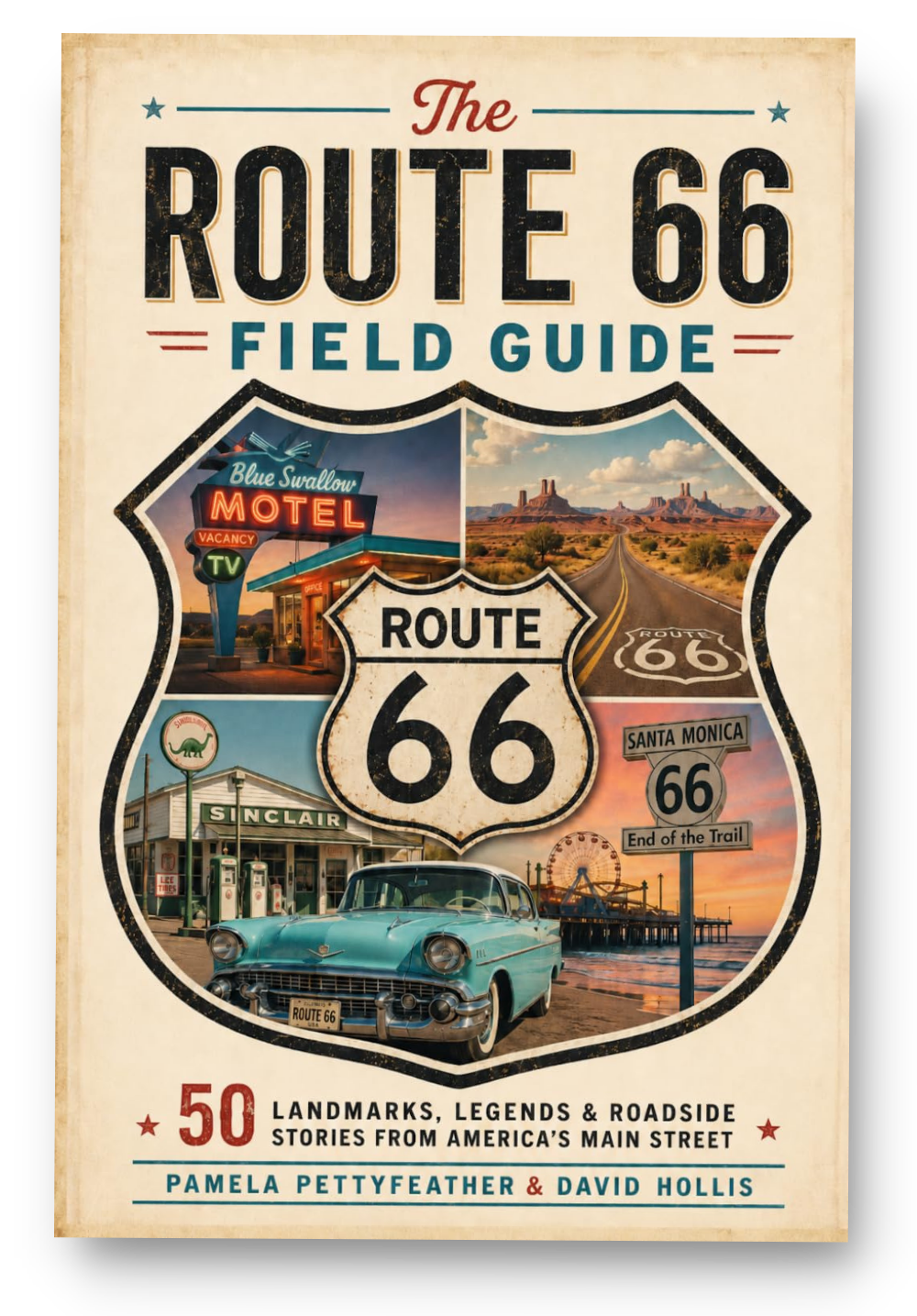
This article draws from The Route 66 Field Guide: 50 Landmarks, Legends & Roadside Stories from America's Main Street, a 50-landmark guide to Route 66 across all eight states.