
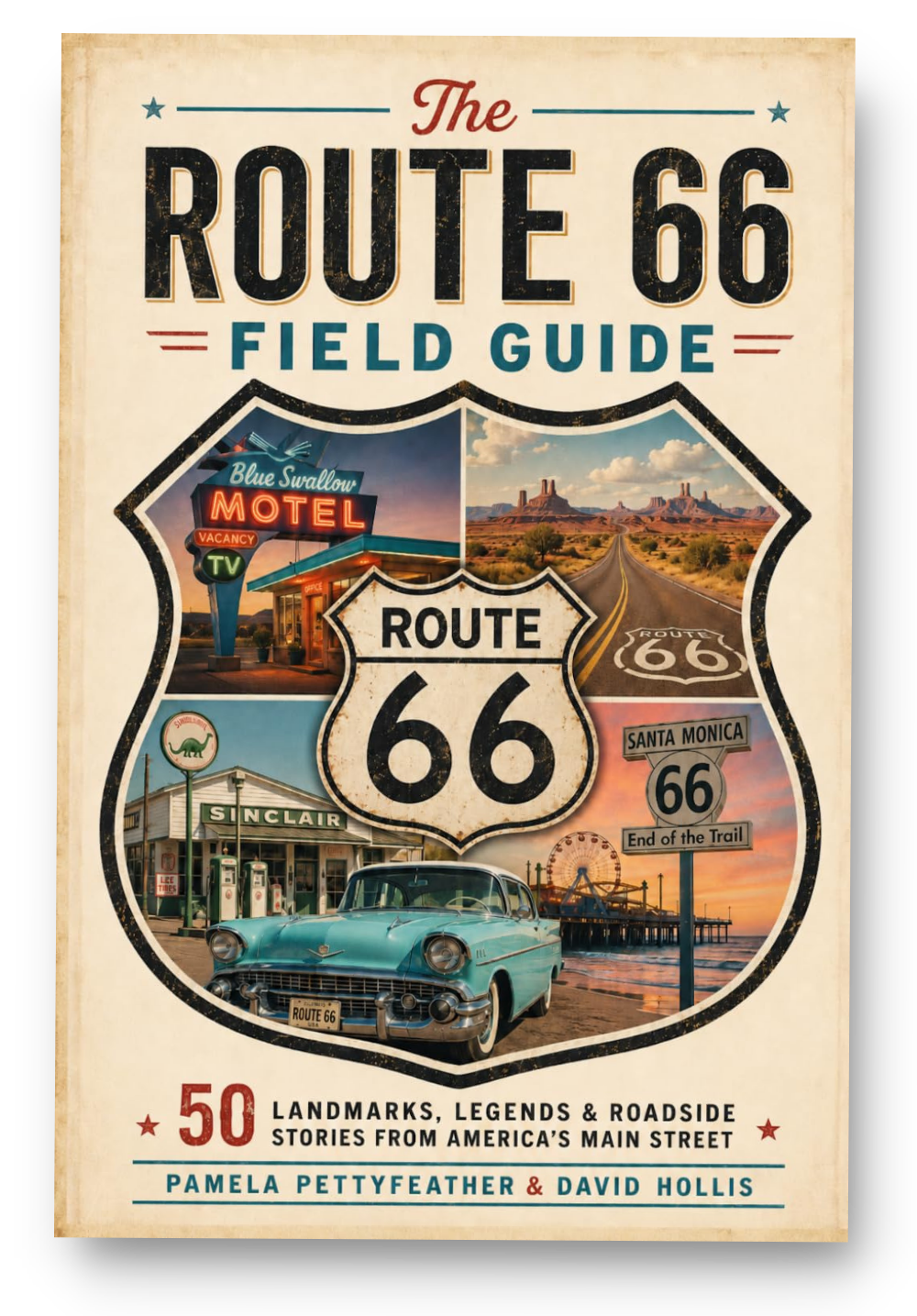
This article draws from The Route 66 Field Guide: 50 Landmarks, Legends & Roadside Stories from America's Main Street, a 50-landmark guide to Route 66 across all eight states.
Cadillac Ranch & Route 66 Texas: A Guide to the Panhandle Drive
The Texas Panhandle does not ease you in. The landscape announces itself at the Oklahoma border and sustains the announcement for the full 178 miles to New Mexico: a sky so large it crowds the horizon on all four sides, a road that goes straight for distances that turn the vanishing point into a destination, and a flatness so complete that a water tower in Groom (deliberately installed at a ten-degree lean) is visible from twelve miles away and registers immediately as wrong. This is the Route 66 that requires no scenic overlook, because the view from the highway is the view.
The Texas section is not the longest stretch of Route 66, but it is among the most distinctive. The Llano Estacado (the Staked Plains) creates driving conditions unlike those anywhere else on the route: extreme distance, extreme weather, extreme clarity of light on days when the wind has scoured the atmosphere clean. The towns along this corridor (Shamrock, McLean, Groom, Amarillo, Adrian, Vega) developed in a specific economic window between the highway's postwar peak and the interstate bypass, and each one carries the marks of that window in its commercial architecture. The panhandle is where Route 66 looks most like what people imagine when they imagine Route 66: empty road, working windmill, a diner that has been open since before anyone currently alive can remember.
And then there is Cadillac Ranch, the most recognizable artwork on route 66 and one of the defining American public installations of the twentieth century.
Cadillac Ranch: Quick Facts
Location: 13651 I-40 Frontage Road, Amarillo, Texas (¼-mile walk from road) Created: 1974, by Ant Farm art collective (Chip Lord, Hudson Marquez, Doug Michels) Commissioned by: Stanley Marsh 3, Amarillo helium millionaire and art patron The cars: 10 Cadillacs, 1949 Club Sedan through 1963 Sedan de Ville Orientation: Buried nose-first at the angle of the Great Pyramid of Giza Admission: Free, open 24 hours | Spray painting: Encouraged (bring your own can) Moved: 1997, two miles west of original 1974 location
Cadillac Ranch on Route 66 is the most visited public artwork in Texas and one of the most photographed installations in the United States. The cars trace the rise and fall of the tail fin across postwar Cadillac design history, a compressed timeline of American automotive ambition, planted in a Texas wheat field.
Cadillac Ranch, Amarillo. What It Is and Why It Matters
Ten Cadillacs stand nose-down in a field west of Amarillo, buried at an angle matching the slope of the Great Pyramid of Giza and painted in whatever color the most recent visitor's spray can happened to be. From a distance they read as a puzzle, the shapes are wrong for what they are, the scale is wrong for the setting, the colors are wrong for a farm field in the Texas panhandle. Up close, standing at the fence line with the smell of fresh aerosol in the wind, the puzzle resolves into something considerably more interesting: one of the most coherent public artworks in the United States, made by three people in 1974 in a wheat field, for an audience of passing motorists who were not asked their opinion.
Cadillac Ranch was created by Ant Farm, a San Francisco-based art and architecture collective comprising Chip Lord, Hudson Marquez, and Doug Michels, under the patronage of Stanley Marsh 3, an eccentric Amarillo landowner and businessman who spelled his name with a numeral because he considered Roman numerals a form of pretension. Marsh commissioned the installation and provided the land; Ant Farm provided the concept and the execution. The collaboration was productive and, on both sides, deeply Texan in its confidence.
The ten cars span the 1949 Cadillac Club Sedan to the 1963 Sedan de Ville, a range chosen to trace the specific arc of the tail fin's rise and fall across postwar American automobile design. The tail fin appeared as a design element on Cadillacs in 1948, grew through the following decade into the extravagant upswept forms that defined the late 1950s, and then declined sharply in the early 1960s under pressure from changing taste and Ralph Nader's safety advocacy. The cars at Cadillac Ranch embody that timeline physically: the fins are modest on the 1949 model at one end, reach their peak exuberance in the late-1950s cars at the midpoint, and taper toward something more restrained at the 1963 end. The installation is buried with the fins pointing skyward, so the sequence reads from the driver's seat of a passing car as a single argument about American automotive ambition stated in chrome and steel.
That argument is about more than cars. Ant Farm was interested in American consumer culture, in the mythology of the automobile as a vehicle of freedom and aspiration, and in the gap between what objects promise and what they deliver. Burying the Cadillacs nose-first, the iconic symbol of American luxury and aspiration planted in Texas dirt, the fins still pointing skyward, a gesture that lands somewhere between monument and burial, between celebration and critique. The ambiguity is not accidental. Ant Farm was a conceptual art collective, and Cadillac Ranch is a conceptual artwork that happens to be accessible from Route 66, which is possibly the best thing that can be said about either.
The 1997 Move
The installation was originally located west of Amarillo on the old Route 66 alignment, closer to the city. Amarillo's development eventually encroached on Marsh's land, and in 1997 the cars were moved two miles further west to their current location off Interstate 40. The move preserved the installation without altering its character, the new site is if anything more open and less encroached, with the panhandle sky doing more of the compositional work than the urban edge the original location provided.
Visiting Cadillac Ranch
The spray paint is not incidental. Visitors are explicitly invited to paint the cars, which means the surface of each Cadillac is a palimpsest of every visitor who has come before: layers of aerosol paint accumulated to an inch or more on the oldest sections, new color applied daily, the underlying automotive metal essentially theoretical at this point. The color changes every day. There is no "original" surface left to preserve, which is the correct condition for an artwork about obsolescence and transformation. Bring a can. The etiquette is minimal: paint something, photograph it, accept that it will be painted over by the time the sun goes down.
Visiting Cadillac Ranch: 13651 I-40 Frontage Road, Amarillo. Free and open at all hours. Parking on the dirt pullout along the frontage road. The walk from the road to the cars is approximately a quarter mile across open field, which is longer than it looks and muddier than expected after rain. No facilities on site.
The Rest of Texas: Seven More Reasons to Drive the Panhandle
U-Drop Inn: Shamrock
The U-Drop Inn rises from the flat eastern panhandle in a form so specifically Art Deco that it appears to have been transported from a more architecturally ambitious city and set down in Shamrock without explanation. The conical tower, the curved wings, the streamline horizontal lines: architect J.C. Berry's 1936 design was a deliberate signal visible from miles of flat road. This is not a roadside shack, this is a destination and it remains one of the finest examples of programmatic commercial architecture on the route.
The building operated for decades as a restaurant and gas station and is now a Chamber of Commerce visitor center, its exterior restoration meticulous. The Pixar team cited it as a visual reference during the development of Cars, making it one of two Texas landmarks on Route 66 with an animated afterlife. Approach from the east on Highway 83 to let the tower appear on the horizon in stages, which is precisely how Berry intended the building to be seen.
Leaning Water Tower: Groom
Ralph Britten installed the water tower outside his Groom truck stop at a deliberate ten-degree lean in the 1980s, reasoning correctly that a straight water tower is invisible from the interstate at speed and a leaning one is not. The truck stop is long closed. The tower continues to lean. It contains no text, makes no claims, sells nothing and it is still performing exactly the function for which it was designed: producing the specific cognitive response (that tower is leaning) that reliably slows traffic.
The tower is a masterpiece of roadside problem-solving in its most stripped-down form. The Leaning Tower of Groom has no engineering flaw. It was built with the lean incorporated into the foundation, making it structurally sound in exactly the direction it appears to be failing.
Big Texan Steak Ranch: Amarillo
Bob Lee opened the Big Texan in 1960 with a promotional premise calibrated not to be impossible, merely improbable: eat a 72-ounce steak (plus shrimp cocktail, salad, roll, and baked potato) in sixty minutes or less, and the meal is free. Fail, and you pay $72. The challenge has since been completed by competitive eaters at speeds that the restaurant has essentially stopped treating as benchmarks, a thirteen-year-old girl, and several thousand other participants whose results vary widely.
The dining room seats challengers on a raised platform at the center of the room, where the rest of the restaurant can observe their progress, which is a theatrical arrangement that tells you exactly what kind of institution the Big Texan is: a place where the meal is also a performance and the transaction involves more than food and money. The yellow longhorn limousines that pick up guests from nearby hotels are not incidental details. They are load-bearing elements of the experience.
Midpoint Sign: Adrian
A sign in Adrian, Texas, announces the precise geographic midpoint of Route 66: 1,139 miles from Chicago, 1,139 miles from Santa Monica. The Midpoint Café across the road has been serving travelers since 1928. The pie is called Ugly Crust Pie. It is better than the name suggests.
The midpoint designation is mathematically accurate and emotionally significant in a way that is difficult to fully anticipate until you are standing in front of the sign in the Texas panhandle with half the continent behind you and half ahead. The Llano Estacado provides no scenic reinforcement for the moment, the landscape looks identical in both directions, which is its own kind of honesty about what Route 66 is asking of the people who drive it.
The Abandoned Panhandle Stretches
The Texas panhandle produced some of the most complete examples of Route 66 abandonment anywhere on the highway: motels caught at the precise moment the interstate redirected their business, their signs still legible, their pool decks still poured, their ice machine brackets still bolted to the exterior walls. A separate guide to Route 66 ghost towns covers the broader context, but the Texas panhandle is worth driving slowly even outside the named stops: the frontage roads between Shamrock and Amarillo pass several abandoned motor court properties whose condition reflects the specific fate of a business model that existed because a road needed it to.
Windmill and Open Highway: Panhandle Country
There is a point on the Texas panhandle alignment where the road goes straight for long enough that the vanishing point becomes a genuine destination. A windmill turns in a field, doing what panhandle windmills have done since the 1880s: pulling water from the Ogallala Aquifer for livestock that would otherwise have nothing to drink in this country. The wind is audible. The sky is enormous. The highway does all the work of giving this flat landscape its meaning.
This is the Route 66 that does not appear on most lists of landmarks, and which many drivers pass through at speed on the way to the things that do. It rewards a full stop with the engine off, two or three minutes of standing on the shoulder and listening to what the panhandle sounds like when you are not moving through it.
Driving Route 66 Through Texas: What to Know
Entry from Oklahoma: The Texas alignment picks up at the Oklahoma border near Shamrock, where the U-Drop Inn is the first significant stop heading west.
Exit into New Mexico: The Texas alignment ends at Glenrio, a ghost town straddling the state line that is itself worth a slow pass; see the Route 66 Ghost Towns guide for detail.
Length: Approximately 178 miles of Route 66 alignment through Texas, running entirely through the Panhandle.
Driving time without stops: Three to three and a half hours. With the major stops (U-Drop Inn, Leaning Tower, Big Texan, Cadillac Ranch, Midpoint Sign) allow a full day.
Weather: The panhandle is serious country meteorologically. Summer temperatures exceed 100°F regularly; winter produces ice storms and visibility-reducing dust. Spring generates significant tornado activity. Check conditions before driving the open alignment sections, which offer no shelter and limited cell coverage in places.
Fuel: Fill up in Shamrock, Amarillo, and Adrian. The stretches between are long and the frontage road services are sparse.
The Big Texan is worth a meal regardless of the challenge. The steak is legitimately good and the dining room's theatrical layout (challengers elevated at center stage, everyone else watching) is an experience that requires no participation to be worthwhile.
The Full Texas Route 66 Drive: Go Deeper
The seven Texas panhandle stops above (Cadillac Ranch, U-Drop Inn, Leaning Water Tower, Big Texan, Midpoint Sign, the abandoned motor court corridor, the open panhandle highway) are all covered at full depth in Route 66 Road Trip: 50 Landmarks, Legends & Roadside Stories from America's Main Street, the Route 66 centennial guide. The Cadillac Ranch entry goes deeper into Ant Farm's argument about consumer culture and what Stanley Marsh 3 was actually commissioning when he pointed three San Francisco artists at a Texas wheat field in 1974.
The book covers all fifty Route 66 landmarks across all eight states, available June 2, 2026.
Frequently Asked Questions
What is Cadillac Ranch? Cadillac Ranch is a public art installation created in 1974 by the San Francisco art collective Ant Farm, commissioned by Amarillo businessman Stanley Marsh 3. Ten Cadillacs spanning the years 1949 to 1963 are buried nose-first in a field west of Amarillo at an angle matching the Great Pyramid of Giza. The cars were chosen to trace the rise and fall of the tail fin in American automotive design. Visitors are invited to spray-paint the cars, and the surface changes daily.
Where is Cadillac Ranch? Cadillac Ranch is located at 13651 I-40 Frontage Road, Amarillo, Texas, approximately ten miles west of central Amarillo off Interstate 40. It is accessible from the I-40 frontage road and involves a quarter-mile walk across an open field from the parking area.
Is Cadillac Ranch free? Yes. Cadillac Ranch is free and open to the public at all hours. There is no admission fee, no ticket, and no staffed entrance. Parking is on the dirt pullout along the frontage road.
Can you spray paint the cars at Cadillac Ranch? Yes. Spray painting the cars at Cadillac Ranch is not only permitted but encouraged. Visitors regularly bring their own aerosol cans and add to the constantly changing surface of the installation. The paint layers have accumulated to significant depth on the older sections. There are no restrictions on color or content beyond those that apply to public property generally.
Why is Cadillac Ranch famous? Cadillac Ranch is famous because it is one of the most successful American public artworks of the twentieth century: simultaneously a serious conceptual statement about consumer culture and car mythology, a participatory installation that changes daily, and an immediately recognizable landmark visible from one of the country's most traveled corridors. Its accessibility (free, open at all hours, on Route 66) has made it a genuine popular landmark rather than an institutional one.
Who made Cadillac Ranch? Cadillac Ranch was created by Ant Farm, a San Francisco-based art and architecture collective consisting of Chip Lord, Hudson Marquez, and Doug Michels. It was commissioned and funded by Stanley Marsh 3, an Amarillo businessman and art patron who provided the land and resources for the installation.
What Route 66 stops are in Texas? The major Route 66 landmarks in Texas are Cadillac Ranch (Amarillo), the U-Drop Inn (Shamrock), the Leaning Water Tower (Groom), the Big Texan Steak Ranch (Amarillo), and the Midpoint Sign (Adrian). The panhandle also contains significant examples of Route 66 abandonment, including several notable ghost town stretches between Shamrock and Glenrio at the New Mexico border.